TO VIEW HISTORICAL TELEMETRY
Global Crisis Index (GCI) Engine v3.13
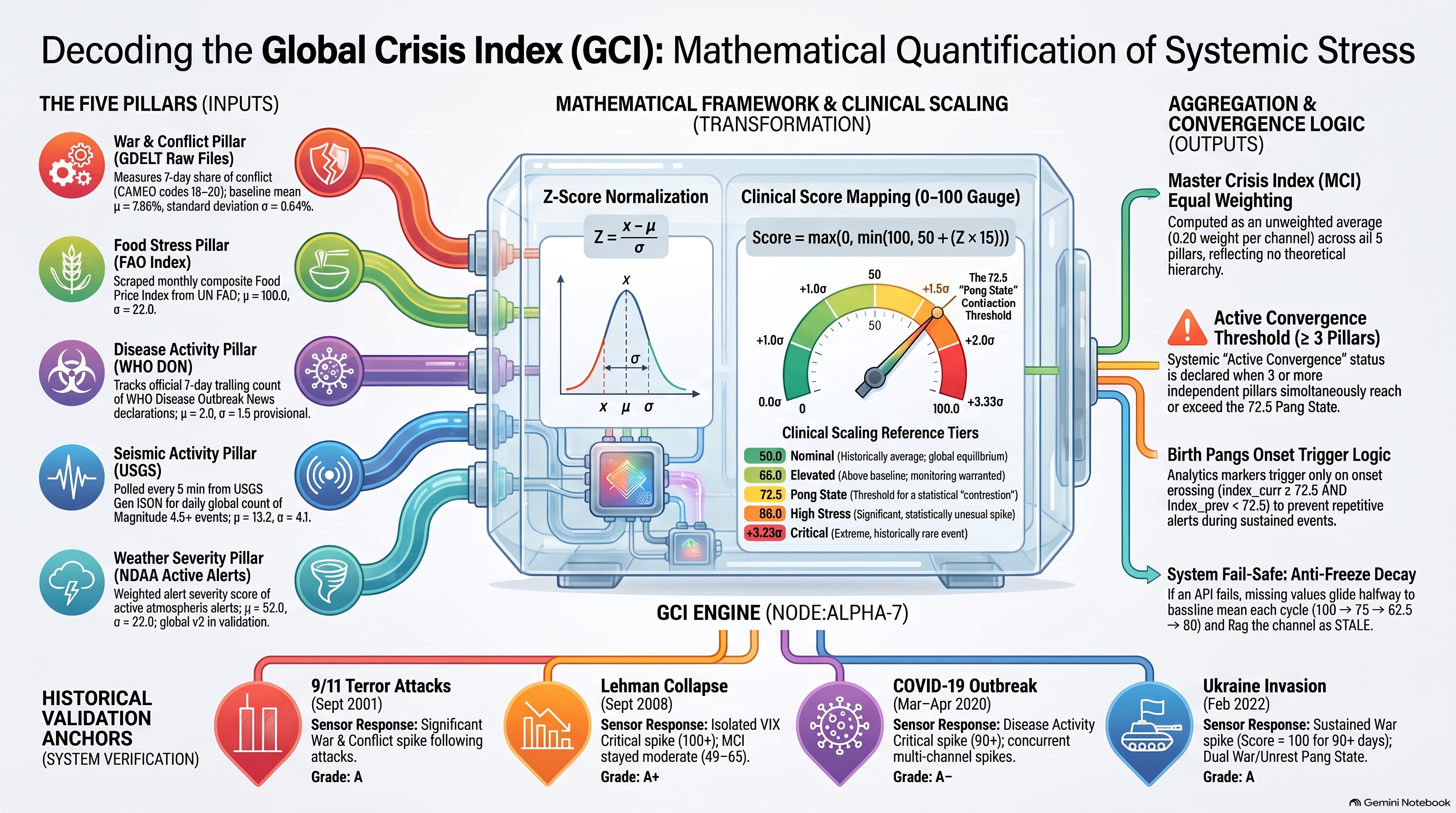
Infographic shows the previous ten-channel design (through v3.12). The live index now uses the five core channels described below; an updated graphic is in preparation.
1. Strategic Overview & Technical Mission
The Global Crisis Index (GCI) Engine, designated NODE:ALPHA-7, is a high-precision clinical instrument engineered to quantify global volatility by transforming disparate, high-velocity data streams into a unified metric of systemic stress. The mission is to transition global risk assessment from "sensationalist speculation" to clinical analysis — utilizing a statistical framework to measure the "heartbeat" of planetary stability.
"Can the 'birth pang' conditions described in the Olivet Discourse be measured mathematically, and do they show measurable escalation over time?"
— GCI Mission Thesis | Matthew 24, Mark 13, Luke 21
This architectural approach treats systemic stress not as a singular event, but as a measurable sequence of "contractions" — a statistical pattern of increasing frequency and intensity in global stressors. The engine triages five independent data channels — one for each of the signs named in Matthew 24 (war, famine, pestilence, earthquakes) plus a natural-calamity proxy — to identify patterns of sustained global compression.
The Five Pillars of Global Stability (v3.13)
| # | Category | Primary Sensor | Proxy Metric |
|---|---|---|---|
| 01 | War & Conflict | GDELT (raw event files) | 7-Day Conflict-Event Share (CAMEO 18–20 as a percentage of all coded events) |
| 02 | Food Stress | FAO (United Nations) | Monthly Food Price Index (Scraped Composite) |
| 03 | Disease Activity | WHO Disease Outbreak News | 7-Day Trailing Count of Declared Outbreaks |
| 04 | Seismic Activity | USGS | Daily Global Count of M4.5+ Events |
| 05 | Weather Severity | NOAA | Weighted Alert Severity Score (US atmospheric; global v2 in validation) |
Scope note (12 October 2026): through v3.12 the index tracked ten channels. It was deliberately narrowed to the five above, so that every scored channel maps directly to a sign named in the Olivet Discourse (or, for Weather, its closest measurable proxy). Rumors of War, Civil Unrest, Ethnic Conflict, Economic Stress (VIX) and Humanitarian (GDACS) were retired from the Master Index and the dashboard. Their data continues to be collected for research, and GDACS remains a source (it supplies tropical-cyclone alerts to Weather v2). Historical readings recorded under the ten-channel design are preserved unchanged.
2. Mathematical Framework: Z-Score Normalization & Clinical Scoring
To resolve the "apples to oranges" problem inherent in comparing seismic event counts against commodity price indices, the GCI Engine utilizes Z-score normalization. This measures how a current observation (x) deviates from its historical mean (μ) relative to its standard deviation (σ).
The Normalization Formula
Each category is normalized against an empirical baseline — long-run history where it exists (e.g. 10 years of USGS seismic counts), provisional values for newer sensors (marked †) until enough live data accumulates to calibrate them. The Z-score is mapped to a clinical 0–100 scale with historical normal centered at exactly 50. The output is hard-clamped at the floor and ceiling.
Z = ( x − μ ) / σ Score = max( 0, min( 100, 50 + (Z × 15) ) )Empirical Baselines (μ and σ)
| Channel | Mean (μ) | Std Dev (σ) | Source / Context |
|---|---|---|---|
| Seismic | 13.2 | 4.1 | USGS M4.5+ daily count, 10-year global average |
| War & Conflict | 7.86 | 0.64 | GDELT 7-day conflict-event share (%), frozen from 89 rolling windows, 7 Jul–3 Oct 2026 (v3.11) |
| Disease † | 2.0 | 1.5 | WHO DON — 7-day trailing outbreak-declaration count — provisional |
| Food | 108.0 | 22.0 | FAO Food Price Index (2014–16 base period = 100) |
| Weather | 52.0 | 22.0 | NOAA active alert weighted severity score (v3.3.1) — replacement in validation |
† Provisional baseline. Disease uses the v3.4 WHO DON migration (September 2026), which replaced RSS headline-keyword matching with a 7-day trailing count of official WHO outbreak declarations; its baseline will be recalibrated once ~30 days of live post-migration data accumulate. The War & Conflict baseline was frozen once, on 4 October 2026, so that a prolonged conflict is not "normalized away" by a rolling window.
Clinical Scaling and Interpretation
| Z-Score Deviation | Index Score | Status | Interpretation |
|---|---|---|---|
| 0.0σ | 50 | Normal | Historically average; global equilibrium. |
| +1.0σ | 65 | Elevated | Above baseline; monitoring is warranted. |
| +1.5σ | 72.5 | Pang State | Threshold for a statistical "contraction." |
| +2.0σ | 80 | High Stress | Significant, statistically unusual spike. |
| +3.33σ | 100 | Critical | Extreme, historically rare event. |
The 72.5 Pang State threshold is the engine's primary heuristic trigger. When an individual pillar crosses this threshold, it signifies a significant deviation from its historical norm and contributes to the Master Index convergence logic.
3. The Master CRISIS Index (MCI) & Logic Tiers
The Master Crisis Index (MCI) is the final aggregate — the systemic "heartbeat." As of v3.13 (October 2026) it is the equal-weighted average of five channels that map to the signs named in Matthew 24 — war, famine, pestilence, and earthquakes — plus Weather Severity as the closest measurable proxy for natural calamity.
Category Weights (Total = 1.00)
| Channel | Weight |
|---|---|
| War & Conflict | 0.20 |
| Food Stress | 0.20 |
| Disease Activity | 0.20 |
| Seismic Activity | 0.20 |
| Weather Severity | 0.20 |
| TOTAL | 1.00 |
Equal weighting is deliberate: the Olivet Discourse names these signs without ranking them, so the instrument does not either. Weights will be revisited only after the data shows which channels behave as reliable live signals.
Convergence Status Logic
The engine evaluates convergence based on the number of channels simultaneously in a Pang State (Score ≥ 72.5). All five channels — War, Food, Disease, Seismic, and Weather Severity — count toward convergence equally.
| Channels in Pang State | Status | Condition |
|---|---|---|
| 3 or more | ⚠ ACTIVE CONVERGENCE | Full simultaneous compression threshold reached. |
| 2 | ELEVATED | Dual-vector stress; below convergence threshold. |
| 1 | MONITORING | Single-channel contraction detected. |
| 0 | NOMINAL | All channels within historical norms. |
Birth Pangs Onset Detection
The Analytics dashboard "Birth Pangs Bracket" marks only an onset crossing — sustained elevated readings do not re-trigger the bracket marker:
Indexcurr ≥ 72.5 AND Indexprev < 72.5Clinical Posture: The GCI is an observation instrument, not a prediction engine. It does not set dates or forecast the future. Every score is mathematically traceable from raw data source to the 0–100 gauge display.
4. Data Acquisition Architecture & API Integration
System integrity is maintained through an automated polling cycle at 05:00 UTC via a Cron job on NODE:ALPHA-7. The acquisition layer applies specific protocols to ensure signal purity and high-fidelity telemetry.
Disease is sourced from the World Health Organization's official Disease Outbreak News record (v3.4, September 2026) — a vetted register of declared outbreak events, not a media-coverage proxy — via WHO's public JSON API.
War & Conflict has been scored from GDELT's raw event files since 3 October 2026 (v3.11), replacing the rate-limited search API. The measure is the 7-day conflict share — events coded CAMEO 18 (assault), 19 (fight), and 20 (mass violence) as a percentage of all coded events over the last 7 days. Using a share removes swings in news volume (GDELT codes ~35% fewer events of every kind on weekends); the 7-day window removes the weekday cycle. The series changed scale on that date, so history analysis should treat 3 October 2026 as a calibration epoch.
In validation (October 2026): a replacement sensor for Weather Severity is running in shadow mode — logged every cycle alongside the published value, but not scored until its baseline is calibrated and the switch is announced here and on The Brief.
- Weather Severity v2: global scope, averaging three components — active tropical cyclones worldwide weighted by wind speed (from GDACS); severe and extreme US alerts counted once per event and forecast office rather than per zone; and official orange/red severe weather warnings from the national meteorological services of ~37 European countries (MeteoAlarm), counted as distinct country/type/level combinations. The current US-only all-alert score regularly saturates at 100 and cannot show escalation; the replacement is designed to keep headroom. Target switch: late October 2026.
API Integration Protocols
| Channel | Source | Protocol Notes |
|---|---|---|
| Seismic | USGS | Direct GeoJSON polling of the M4.5+ 24-hour feed. Updated every 5 minutes globally. |
| War & Conflict | GDELT raw event files | Trailing 7 complete UTC days of 15-minute event files; conflict share = CAMEO 18–20 events / all coded events. No API key and no rate limit. If a day's files are missing the window is incomplete and the channel decays toward baseline (see §6) rather than scoring a partial week. |
| Disease (v3.4) | WHO Disease Outbreak News | Public JSON API — who.int/api/news/diseaseoutbreaknews, sorted by publication date, no key required. Raw signal is a 7-day trailing count of official outbreak declarations, not a headline-keyword match. |
| Food | FAO | Scraped from FAO World Food Situation page. Published monthly; static between updates. On scrape failure, decays toward baseline and is flagged STALE. |
| Weather | NOAA (US); GDACS and MeteoAlarm in validation | api.weather.gov/alerts/active — no API key required. Each alert weighted by event type severity (see table below). Weather v2 adds GDACS tropical-cyclone alerts and MeteoAlarm European warnings in shadow mode. |
NOAA Alert Type Weights (current Weather score)
| Alert Type | Weight |
|---|---|
| Tornado Emergency / Hurricane Warning | 8 |
| Flash Flood Emergency | 6 |
| Tornado Warning / Storm Surge Warning | 5 |
| Hurricane Watch / Tropical Storm Warning | 4 |
| Severe Thunderstorm / Ice Storm / Blizzard Warning | 3 |
| Tornado Watch / Flash Flood Watch / High Wind Warning | 2 |
| Heat Advisory / Fire Weather Watch / All Other Advisories | 1 |
Signal Purity
Counts that cannot be inflated by volume. War is measured as a share of all coded events, so a busy or quiet news day does not move it; Disease counts official WHO declarations, not headlines; Weather v2 counts distinct events and warnings rather than per-zone or per-language duplicates, which is what made the original all-alert sum saturate.
Curated briefing sources. The daily briefing reads only a fixed pool of Tier-1 news feeds (BBC, PBS NewsHour, The Guardian, NPR, Al Jazeera, France 24, UN News), so entertainment, lifestyle, and opinion outlets never enter the pipeline. Headlines are deduplicated across feeds, and a headline must be confirmed by at least one primary source before it is used.
5. Database Schema & Persistence Layer
The GCI Engine utilizes a MySQL backend to enable longitudinal trend analysis and historical validation. Production database: sentoadu_GCI on NODE:ALPHA-7.
| Table | Purpose | Key Fields |
|---|---|---|
| gci_history | Timestamped normalized scores + Master Index + Executive Briefing narrative with cited source metadata | master_index, war_conflict_score, rumors_of_war_score, seismic_score, seismic_raw_count, disease_score, food_score, vix_score, weather_score, weather_raw, gdacs_score, unrest_score, ethnic_conflict_score, convergence_status, data_source, timestamp |
| visitor_counter | Single-row page-hit counter (atomic increment) | id, hits |
Channel scores are stored with decimal precision (since 2026-09-29; earlier rows are whole numbers). Raw sensor values that the scores are computed from — the USGS earthquake count and the NOAA weighted alert score — are stored alongside them so baselines can be recalibrated from real data rather than from clipped scores. Shadow sensors in validation write to separate log files, not to gci_history. Columns for the channels retired in v3.13 remain in the table and keep collecting data for research, but they do not feed the Master Index.
Smoothing
No scored channel is smoothed: each of the five reads its own value for the cycle. (Through v3.12 a 3-period moving average was applied to Civil Unrest and Ethnic Conflict to prevent single-cycle spikes; it is retained only for those retired, logged-only channels.)
6. Data Integrity & API Fail-Safe Protocols
Crisis monitoring requires high-availability data. NODE:ALPHA-7 implements multiple fail-safe layers to maintain telemetry continuity under external API degradation.
| Failure Mode | Protocol |
|---|---|
| API Timeout / Non-200 Response | Anti-freeze decay (v3.2): the engine back-calculates the last raw value from gci_history and moves it halfway toward the baseline mean each failed cycle (e.g. 100 → 75 → 62.5 → 56). A dead sensor visibly glides to 50 instead of freezing at its last reading, and the dashboard marks the channel STALE with a day count (v3.5 instrument-health badges). |
| GDELT File Gap (formerly 429 Rate Limit) | Retired as a failure mode: since v3.11 War reads GDELT's raw file server, which has no rate limit. A missing day in the 7-day window triggers anti-freeze decay rather than a partial score. |
| FAO Scrape Failure | Anti-freeze decay and STALE flag, as above. |
| Remote Briefing Upload | PIN-protected portal at /upload. The PIN and all service credentials are held in a server-side configuration file outside the application code. Maximum file size 500MB. Accepts MP3, MP4, MOV, and WEBM. |
Calibration Note (as of 2026-10-12): War & Conflict is on its v2 scale (calibrated 4 October 2026, baseline frozen). Disease Activity (μ=2.0, σ=1.5) is provisional: recalibrate once ~30 days of WHO DON data accumulate after the v3.4 migration. Weather Severity currently reads the US-only all-alert score, which is saturated at the 100 ceiling; the v2 replacement (tropical cyclones, severe US alerts, European warnings) is in shadow mode and will be calibrated from 2–3 weeks of logs, with a target switch in late October 2026 and a recalibration planned after a full year of data. Until the switch, a Weather Pang State should be read with that saturation in mind. Every switch is dated in the engine changelog and announced on The Brief, so readers can see exactly where a series changes method.
7. Analytical Interface & Historical Validation
The dashboard translates backend telemetry into actionable intelligence, providing tools to validate sensor accuracy against known historical anchors. Use the Analytics Tab to query date ranges and compare GCI output against verified crisis events.
Historical Validation Anchors
| Event | Expected GCI Signal | Grade |
|---|---|---|
| September 2001 | Significant War & Conflict spike following 9/11 attacks. Pre-2013 data uses calibrated historical estimates (GDELT dataset begins 2013). | A |
| March–April 2020 (ten-channel era) | Disease Activity Critical spike (90+) at COVID-19 pandemic declaration. Concurrent VIX and Unrest spikes confirm multi-channel convergence model. | A− |
| February 2022 (ten-channel era) | Sustained War spike at Ukraine invasion onset. War=100 for 90+ days. Dual War/Unrest Pang State confirms convergence logic integrity. | A |
| September 2008 (ten-channel era) | Isolated VIX Critical spike (100+) at Lehman collapse. Master Index 49–65 — validates single-channel vs. convergence model distinction. | A+ |
Anchors marked "ten-channel era" were graded on readings recorded when VIX and Civil Unrest were part of the index (through v3.12). Those two channels are no longer scored, so the live five-channel index would not reproduce the VIX- and Unrest-dependent signals described here (notably the isolated-VIX 2008 case). The recorded history is preserved as published.
Dashboard Architecture (v3.13)
| Column | Channels | Category |
|---|---|---|
| Left | Tech Bulletin — latest episode preview and transcript | Briefing |
| Center |
Global Marker Trackers — one card per channel with score, 10-day delta, and
instrument-health badge (STALE / SAT / FLOOR / FLAT) Convergence Delta — cross-channel narrative for the current cycle 7-Day Trend — Master Index and channel lines with Pang threshold |
All Channels |
| Right | System Status (convergence badge), Intelligence & Metrics, Channel Telemetry | Status + Intel |
Future Roadmap
- AI Pattern Recognition: Machine learning analysis of the full historical dataset to determine if contraction frequency is mathematically increasing over time.
- 7-Day Rolling Averages: Delivered on the Analytics tab (v3.9) as a 7D AVG overlay for any single channel, alongside a raw M4.5+ earthquake-count overlay. Next: trend arrows per channel on the dashboard cards.
- Predictive Maturation: Integration of leading-indicator signals to provide early warning of cross-channel convergence before individual Pang State thresholds are reached.
Frequently Asked Questions




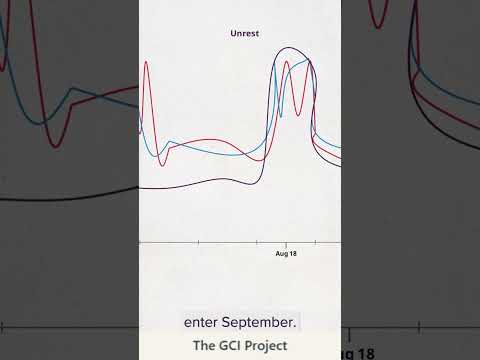
▸ Ukraine : War-saturated, sustained
▸ 2008 Crash : VIX isolated, master moderate
▸ Arab Spring: War + Seismic dual overlap
✓ All four produce distinct signatures
3+ months elevated
Grade: A−
War=100 for 90+ days
Grade: A
Single-channel event
Grade: A+
Dual-crisis overlap
Grade: A